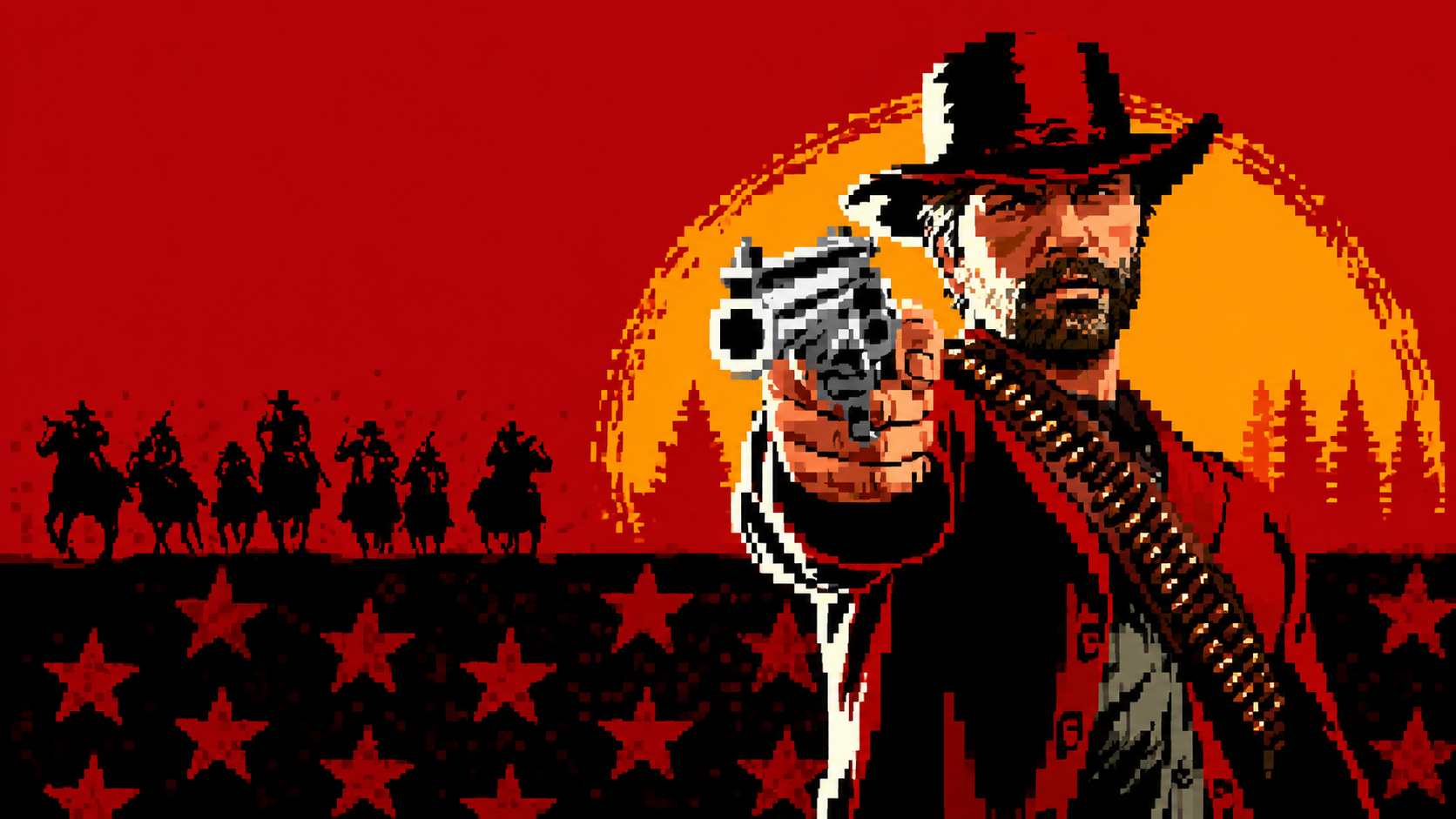
I just replayed Red Dead Redemption II, the critically acclaimed action-adventure game developed and published by Rockstar Games in 2018. I played this game for the first time some years ago, but I figured it'd be fun to write a review for it, as it truly is one of the greatest games ever made, and I say that with no exaggeration.
◆ INTRODUCTION
Rockstar Games has always been an impressive producer of videogames, with each of their releases being considered "masterpieces" in their own right, and it is not hard to see why. Rockstar puts a tremendous amount of detail, research, writing, and strenuous effort into their massive games, and RDR2 is no different. You need only look at the overwhelming hype for their upcoming title, Grand Theft Auto VI, for proof of their successful past. Knowing this, I'd like to analyze RDR2 for a bit, if not for my own entertainment, then to introduce you to an incredible piece of the game industry that deserves all the praise it can get.
◆ SETTING
To set the stage I'll start with the setting (imagine that). The game takes place in a parody of America in the year 1899. The Civil War ended a few decades ago, and yet the nation is still recovering from the effects and changes brought about by it, especially in the south. More importantly, this marks a period near the end of westward expansion, or what is more commonly known as the Wild West. Outlaws, or what pop-culture would refer to as cowboys, are a common force seen killing and robbing their way through the west in gangs. Of course, in terms of the game this is exaggerated from real life, but the main takeaway is that up to this point in the setting, these outlaws had free reign of their western territory, that is until the government began hunting them down in attempts to make America a "land of laws" as the game puts it.
You play as one of these outlaws, Arthur Morgan, who is on the run with his fellow outlaws, the Van der Linde Gang, led by the man himself, Dutch van der Linde. Their journey takes them through a handful of made-up states inspired by many southern and western states in America. These include the grassy plains of New Hanover, the rocky and snowy mountains of Ambarino, the dense forests of West Elizabeth, the swampy yet slowly urbanized wetlands of Lemoyne, and the barren deserts of New Austin. The player is free to explore all of these between story missions, and it is truly one of the most impressive worlds ever created in a game.
Rockstar has an incredible eye for detail and replication of the real world. Every minute detail of the architecture in towns, the behavior of NPCs, and the placement and behavior of animals in different climates is a perfect and researched replication of the real world, and considering this is replicating a period from over a century ago, the feat of this setting's existence is just astounding. Even horse testicles don't escape this realism, as they apparently react realistically to in-game weather. That is not a joke! The sheer attention to detail is so good, that a real history professor at the University of Tennessee, Tore C. Olsson, wrote a book about RDR2 that he uses for his classes to teach students about The Old West. The book is called Red Dead's History, and I'll link it in the references at the end.
With such a great setting at its disposal, RDR2 can already be commended for what it has accomplished, but this is a videogame, so of course gameplay required the same attention to detail just to keep up to standard.
◆ GAMEPLAY
In terms of gameplay, RDR2 has a strangely paradoxical style that can often lead to a clashing feel between freedom and linearity. This may seem confusing, but when you play the game it is very noticeable. Most of the main content in RDR2 is contained in super linear story missions. These often consist of heavy dialogue, intense story beats, and scripted gunplay and horse riding. There isn't much choice in the approach of these missions for the player, as the focus is on storytelling more than anything else. This is by no means a bad thing in and of itself, as the story and basic gameplay is so good that the lack of choice isn't much of an issue. Where things get weird, however, is the drastic difference in gameplay when outside story missions.
When you are just exploring the world, you are given hundreds of activities and tools in approaching situations of your choosing. The world outside the story is a sprawling sandbox that lets you hunt, fish, gamble, rob, craft, and about a million other things, which is extremely impressive and fun, but this freedom clashes heavily with the super linear and scripted story. None of this is to say that either of these forms of gameplay are bad, in fact they are some of the most impressive examples of their respective genres, it simply leads to a drastic separation between story and exploration, which ideally should be meshed together to make a more singular and uniform experience.
Regardless, the core gameplay is impressive and fun, so there's not too much room to complain thankfully. Most of what you'll be doing is either horse riding or gunfighting, and I mean that. I'd wager that about half of any playthrough if not more is spent quietly riding your horse through nature, which is quite funny, but since the writing and setting are so good, I and most other players don't mind. The combat is very fun, if not a little easy to overcome. There is a wealth of options for weaponry from rifles, revolvers, pistols, and shotguns, to dynamite, tomahawks, knives, and lassos. Unfortunately, since combat is typically very easy, you won't find much of a reason to experiment and use other tools. The best and quickest method of fighting through the game is simply picking one good weapon and gunning down every enemy in your path. It is more or less a cakewalk, and I imagine that without the story or setting to back it up, this would be criticized pretty heavily. Thankfully, this combat is just fun enough to not get too repetitive, but it gets very close near the end of the game, especially considering this game's insane length.
The only other core mechanic to cover is the Honor System, which acts as a morality rating for the player. Essentially, doing bad things like killing in cold blood or robbing regular civilians lowers honor, while helping people and doing good acts raises it. Your rating can affect many little things like how Arthur interacts with others and even the availability of entire story missions. Generally, it is best to keep honor high, as near the end high honor leads to the best outcomes for the story and the best displays of the game's themes. All that aside, this is just a fun mechanic, and while it is important, if you just want to have fun and be an outlaw you can choose to ignore it just fine. The game leaves it up to you whether you care about being a good person, and that kind of player choice leads to great investment in the game.
I 100% completed this game, experiencing all the game has to offer over a lengthy playthrough, and while this is a great accomplishment, I probably wouldn't do it again. I will always play this game over and over for its story, but the side content requires a level of dedication and time that can really only be put in by the most determined gamer. If you are a casual player, I recommend doing all the main and side missions, but encourage you to take it easy with the smaller challenges and interactions, as some of them are purely time consuming with very little entertaining gameplay outside of the awe at the sheer amount of content. None of it is bad, it is just... a lot.
Regardless of my seemingly mixed comments, the gameplay for this game is fantastic, and absolutely will be fun to anyone, perhaps even more so to someone who just wants to experience the story and most important side content.
◆ STORY
The final and absolute best part of this game is its story, regarded as one of the best stories ever put into gaming. In my opinion, this story is the best I've ever read, watched, or played, and I say that with no exaggeration. This can mostly be attributed to the great character writing for each and every character of the story, no matter how much content they actually take part in. As usual, I'd like to analyze just what makes it so great. If you haven't played the game, please go and do so before reading this, as I promise it's an experience you will not regret.
As I mentioned before, the story revolves around the gang of outlaws known as the Van der Linde Gang, led by Dutch van der Linde, and his right-hand Arthur Morgan, the protagonist and player in the game. The gang is being hunted down by the Pinkerton Agency, a mercenary organization hired by the government to hunt down the last outlaws in the west. They have already killed at least 3 members of the gang by the start of the story, while another member is being held for ransom by bounty hunters. The gang starts off stuck in the mountains after fleeing these people, and throughout the game they are constantly on the back foot having to flee east from their pursuers.
The gang is huge, with each member having great writing and importance in their own right, but for the sake of summary, the most important members are Arthur, Dutch, John Marston (the protagonist of the first game), his son Jack, his wife Abigail, the old and wise Hosea Matthews, and the sadistic Micah Bell. There are many other important characters, but it would be ridiculous of me to cover them all, so please just play the game for the full experience. All you need to know for now is that Dutch is a great and charismatic leader, and he is especially close with Arthur and John, having essentially raised them as a father figure with Hosea, his closest advisor and friend next to Arthur. Micah is disliked by pretty much everyone except for Dutch, who claims to see lots of potential in his sadism, which proves to be partly true due to his incredible experience with firearms.
The story takes you through a handful of classic Western and adventure story tropes, with each of the chapters having a very charming and distinct style and setting from each other. The first, as I said, is in the snowy mountains of the Grizzlies, and while this just serves as a tutorial area, it has a great style and a lonely feeling when exploring, thanks to the harsh weather and lack of civilization. Eventually the weather clears enough for the gang to move into safer territory, which leads to Chapter 2.
Chapter 2 takes place in the more neutral grassy plains of The Heartlands, with nice weather and beautiful views, fitting of the gang's heightened morale at this early point in the story. Arthur establishes his struggles with the outlaw life here, admitting to the gang's inevitable end despite the morale and supposedly free life they seek to lead. The business of robbing, hunting, and bailing out comrades is as usual at this point — that is, until the gang is chased out of the region by Pinkertons and the powerful oil baron they've been robbing, Leviticus Cornwall.
Chapter 3 lands the gang in the outskirts of the swamps in Lemoyne, dubbed specifically as Scarlett Meadows. Here the gang finds themselves stuck between a dispute with two very wealthy families, the Grays and the Braithwaites, both of whom believe they own the region and claim to have mounds of riches in gold. This is one of my favorite story threads in the game, as the gang plays both sides of this feud, attempting to scam them all out of their gold. Arthur protests, as the game they are playing is admittedly dangerous, but his loyalty to Dutch is greater than all else, so he plays along. Unfortunately, both families are discovered to be lying about their riches, and worse, eventually they discover the gang's deception, killing one of them and kidnapping Jack, John Marston's son, selling him to a crime lord in the city of Saint Denis. The gang takes both of these families out, and then go to save Jack.
This leads to Chapter 4, where the gang discovers the Italian crime lord Angelo Bronte. Dutch immediately sweet talks him into releasing Jack, along with getting the gang some work from him. The side-content is at its best at this point, as the big city of Saint Denis is full of unique characters to speak with, and robberies to commit. Unfortunately for the gang, everything goes downhill from here, as Bronte's robbery tip ends up being a setup to get the gang killed. They escape, and Dutch counterattacks Bronte by kidnapping him from his home and killing him in cold blood. This is the first display of Dutch's declining sanity, foreshadowing some much worse events to come. The gang attempts one last robbery in the city after this, but it is suspiciously ambushed by Pinkertons, getting two gang members killed, one of which being Hosea, Dutch's closest friend. John also gets captured in the escape, being taken to prison for the time being. What's left of the gang is forced to go into hiding, while Arthur, Dutch, and Micah must flee the city by stowing away on a boat. Unfortunately again, this boat is hit with a huge thunderstorm that leads to the gang abandoning ship and washing up on the island of Guarma.
This leads to Chapter 5, arguably the weakest of the chapters considering its length, but it has a fun concept as the gang is now stranded on a tropical island far away from the base game's map. Guarma is a cool concept, but the game doesn't allow you to explore it at all, which is a real shame. This is made up for with some cool story moments, as the gang must now hide from the men of Alberto Fussar, a sugar plantation owner who has taken over the island and enslaved the locals there. They help the locals rebel against Fussar, eventually killing him, and the gang secures a boat as reward for their help, leading them back to America to meet up with the gang. Unfortunately, in the process of this Dutch kills another person in cold blood, this time a far more innocent, or at least less personal victim. This serves as a great segue into the final chapter of the main story, where the best and darkest story beats for Arthur, Dutch, and the gang take place.
In Chapter 6, the gang finally reunites after the men return from Guarma, but their reunion is short lived, as the Pinkertons show up immediately to ambush the gang. At this point their constant knowledge of the gang's whereabouts starts to look suspicious, and the idea of a mole, or rat as they call it, in the gang is introduced. The gang thankfully escapes this ambush with no casualties and manage to set up camp in the dense and mountainous forests of Roanoke Ridge. After all the running and death in the gang, morale is very low, and most members are either at each other's throats, or suspicious of each other due to the likelihood of a rat in the gang. This suspicion gets so bad that a gang member is killed after drunkenly admitting her disloyalty. Dutch himself is far less charismatic now, displaying more anger and overconfidence, and likely still recovering from the loss of Hosea from Chapter 4. Micah takes this opportunity of vulnerability to worm into Dutch's ear, and now both of them begin scheming without consulting Arthur or the gang, a clear display of the shift in attitude and power dynamic throughout the gang. Things are no better for Arthur himself, who becomes very sick, coughing up blood and reducing the player's stats. Arthur sees a doctor about this, and unfortunately is diagnosed with tuberculosis, essentially acting as a death sentence for him, especially in a period where treatments for such disease are yet to exist. This event sparks a shift in commitment and attitude for Arthur. For the whole story he has been loyal to Dutch and the gang alone, constantly making remarks on the belief that he and the gang had no choice to do what they do, and no way out. Now that he faces death and the slow yet clear destruction of the gang, he starts to see through Dutch and Micah's ignorance, and how their decisions have led to the state they are all now in. From here on he commits not to the gang or the ideals of Dutch, but to the people in it. He knows the end is coming, and so now just wants to save as many members as he can from their fate.
This new commitment starts with freeing John from prison. You may remember that he was captured by the Pinkertons in Chapter 4. Dutch has repeatedly opposed the idea of freeing John despite the likelihood that he will be hung for his crimes soon. Arthur decides to save him against Dutch's wishes, which angers Dutch, causing an even larger divide between the two. Arthur helps John in making a plan to escape the gang's fate with his wife and child, along with encouraging other members to leave and find a free life for themselves. In the meantime, Dutch and Micah trick Arthur into helping them kill the powerful oil baron Leviticus Cornwall and robbing his men for cash. This is another reckless act that brings the law closer to discovering their position, but the duo assures Arthur this chaos is, "All part of the plan," a term thrown around so much by them in this chapter that it is almost comical just how unplanned their "plan" turns out to be. All Arthur is told is that they are just trying to get enough money to leave the country for good, but any specifics if there are any are left to the minds of Dutch and Micah.
The rest of the chapter revolves around the Wapiti Native American Tribe, who discover the gang earlier in the story, getting help from Arthur in defending their rights to holding their land, which the military, lead by Colonel Favours, is attempting to drive them out of for oil drilling. The chief of the tribe, Rains Fall, has taken a peaceful approach to the matter, attempting to negotiate with the government, while his son Eagle Flies grows resentful of the matter, desiring a war instead. Dutch takes advantage of Eagle Flies's anger by helping him initiate this war against Rains Fall's wishes. Arthur protests, but Dutch rationalizes the matter as creating a distraction for the government. The way he sees it, if the government is busy with a war with the Wapiti, they won't be able to focus on the gang. What's awful is that he doesn't really care about helping the Natives keep their land, essentially exploiting them for his own benefit just like the government. Arthur helps Rains Fall keep the peace where he can, but unfortunately Dutch's influence leads to a war, causing the gang to get wrapped up in fighting the military. Arthur accompanies Dutch and the gang to the battle at the oilfield to protect the natives on behalf of Rains Fall. The battle doesn't go too well for the Wapiti, but Dutch and Arthur are able to break into the main refinery to steal the cash inside. However, Arthur is knocked to the ground by Colonel Favours as they leave, and just for a second it seems that Dutch turns to save him, but he turns and walks out the door, essentially leaving Arthur to die. Thankfully, Eagle Flies saves him, becoming mortally wounded in the process, but allowing Arthur the opening to kill Favours. When Arthur carries Eagle Flies out of the building, Dutch orders him around as if nothing had happened, something Arthur initially confronts, but gives up on as he has to take Eagle Flies back to Rains Fall before he dies. The Wapiti unfortunately must leave their home after everything, and eventually their land becomes an oil refinery, a tragic yet accurate display of how America has treated Natives in the past.
The final missions revolve around one last robbery on a train owned by the military. After this, the gang will be able to buy a boat overseas to supposed freedom from the government. At this point most of the gang members have left, likely seeing the writing on the wall, which Dutch sees as disloyalty and cowardice. Arthur urges him to let anyone remaining go, but he brushes it off. The train robbery itself is successful, with the gang finally making enough money to leave. Unfortunately, John fell off the train in the process, and Dutch informs Arthur that he didn't make it, dismaying him. Arthur's whole main focus was to save who was left, especially John as he has a wife and son, but now he is gone, and what's worse is that when the gang returns to camp it is revealed that John's wife Abigail was kidnapped by the Pinkertons while they were out. Arthur pleads with Dutch and Micah to help save her, but they refuse, seeing her as dead weight. Arthur is thankfully able to secure John's son Jack to safety, but seeing that the gang is symbolically dead now, he takes it upon himself to save Abigail. He finds the Pinkertons' camp and succeeds in a one man shootout with a huge group of them, which is a very fun section of the game, and finally comes face to face with their leader, Agent Milton. Milton has him held at gunpoint, and monologues, revealing that there really was a rat in the gang the whole time, Micah. The Pinkertons' constant knowledge of the gang's location finally makes sense now, as Micah was there through it all, and what's worse is he is now the closest advisor to Dutch. Abigail and Arthur thankfully kill Milton and escape, and Arthur is able to send Abigail to her son. With nothing else to do, and his disease nearing its worst, Arthur makes one last ride to confront Micah, Dutch, and the rest of the gang who have become corrupted by loyalty and dishonor.
Arthur arrives, publicly accusing Micah to the gang, but Dutch and the others don't believe him, and tensions begin to hit their peak. Just then John appears, limping into camp, apparently having survived the train robbery. This is the final straw in any redeeming qualities of Dutch, as it seems he abandoned John, lying to Arthur about his death. John and Arthur are left in a standoff with Micah, Dutch, and what remains of the gang. This is interrupted by more Pinkertons, who have come to finish off the rest of the outlaws. Everyone must run, with Dutch's loyalists running with him, and John and Arthur forced to escape on their own. The player is given one last choice to either help John escape to his family or run back to camp and grab all the money the gang has collected over the game. The obvious best choice is to help John, though the ending doesn't change much regardless, it's just the honorable thing to do. Arthur saves John by drawing the Pinkertons away, essentially sacrificing himself. There is one last battle to be had however, as Micah jumps Arthur at the last second, likely wishing to silence him just in case he tries to reveal his disloyalty to the gang. Arthur unfortunately can't win this fight, as he is so sick that he can barely get up. He gets close, but Dutch appears to finish him off. Arthur makes one last attempt to plead with Dutch before he dies, and for a brief moment as Dutch watches the man he raised like a son dying at his feet, he seems to see the truth. Micah beckons Dutch escape with him, but Dutch, finally seeing Micah's evil, leaves without saying a word. Micah is forced to run off alone, and Arthur finally dies from his beating from Micah and his disease. The ending, while very tragic, has a good outcome, as John and his family survive and go on in hopes of living a free life.
Arthur's character and the ending to the game both help build one of the most incredible stories I've ever played through. It is not only well written, but it covers some incredible themes through each of its characters. Dutch embodies the hypocrisy of American Idealism; how we strive for freedom and justice, while constantly depriving others of freedom and committing unjust acts. The many antagonists embody the cruel expansion of the economy and civilization; whether it is the loss of nature, the loss of equality, or perhaps even an increasing unwillingness to accept challenge or change. And of course there's Arthur, who embodies loyalty, change, and of course redemption. Arthur's change in commitment near the end from the gang and idealism to individuals and kindness is what led to his redemption in the end. His life as an outlaw led to his sickness and the death of many gang members, but his acts at the end were attempts to save what was left. You don't have to forgive his past actions, heck he doesn't even do that for himself, the message is simply that it's never too late to change and make a difference. He was jaded at the world for how cruel it was, and so he became afraid to open his heart to kindness, but eventually he followed the advice of Sister Calderón in the game, quoted below.
The story wraps up with a lengthy epilogue where you now get to play as John Marston. The only notable part for this summary revolves around Micah, who acts as the target of the final mission of the game. After a few years, John has made a home for his family, and has even reunited with a couple of the living friendly gang members. The final mission has John and these members discovering Micah's location and hunting him down to honor Arthur's memory. There is one last gunfight, and Dutch appears one last time, seemingly there to kill Micah as well, but apparently not having the guts to do it, as doing so would essentially be admitting that he is responsible for the death of Arthur and the rest of his gang. However, in the standoff, John convinces Dutch at last to shoot Micah, ending the story once and for all. Dutch walks off silently, and John lets him go, likely not wanting to shoot his father figure even after everything. This epilogue leads straight into the first Red Dead Redemption, as this game is a prequel to that. I haven't played it, but I'm aware that it wraps up the story of Dutch and the other gang members. Regardless, that's the end of the story! A long one I know, and there are a ton of very cool or great parts I didn't mention, but I hope you can see why this game is so great!
◆ CONCLUSION
Overall, RDR2 is one of the most impressive and thought-provoking games I've ever played. With incredible writing, detailed design, and realistic gameplay, it hits all the best parts of Rockstar's skillset. Where it lacks in a more exciting or unified gaming experience, it picks up in story and design. I will always come back to this game to experience the great world it crafted, and I hope I've convinced you to do so as well. Regardless, thank you for reading this terribly long review of a game from 8 years ago. I hope that even if you don't go to play this game afterwards you at least take a lesson from its story. Remember that there is always kindness around you, and it is never too late to spread kindness yourself.
◆ REFERENCES
Red Dead Redemption II (PS4 version) [Videogame]. (2018). Rockstar Games.
Olsson, T. C. (2024). Red Dead's History: A Videogame, an Obsession, and America's Violent Past. St. Martin's Press, an imprint of St. Martin's Publishing Group.